
Something exciting is happening on Saturday mornings.
Twelve K–12 English teachers from across Brazil are currently participating in the Strategies for Teaching English Pronunciation (STEP) Program, an intensive, 10-week journey into the Color Vowel® Approach.
STEP is an initiative of the Colorado Chapter of Partners of the Americas, developed in partnership with Color Vowel® / English Language Training Solutions (ELTS), Community Playthings, and Associação de Servidores da Educação Básica do Piauí (ASSEBEPI). Its purpose is both simple and ambitious: to give Brazilian public-school English teachers access to high-quality professional development in spoken English—and equip them with practical tools they can bring directly back to their students.
These twelve teachers are working hard, and the outcomes are turning out to be even greater than anyone imagined.
Flipped Instruction
The STEP participants are completing our 20-hour Color Vowel® Level 1 Training and Certification in a specially designed format spread across ten weeks.
The curriculum is “flipped”: before each live session, participants work independently through that week’s Color Vowel Basics module, a self-access course featuring video lessons, knowledge tests, and phonological awareness quizzes. They then come together online to explore those ideas in practice—to listen, experiment, ask questions, make mistakes, try again, and connect what we are learning to real classrooms.
More than simply learning, the program aims to transform in language awareness.
Color Vowel training isn't simply about acquiring information about English pronunciation. Participants are learning to hear English differently. They are learning to recognize patterns in stress, rhythm, syllable structure, and vowel sounds that are often difficult to perceive precisely because our first language has trained our ears to listen in other ways.
For teachers, such discoveries can be profound.
After our very first week together, participant Alice reflected:
“Color Vowel shows me groups of sounds and with colors to associate these sounds. Since the first class I've downloaded the book and notice how ingenious the approach is, for example, the use of the open hand to mark the stressed syllable. I'm grateful for the opportunity and I feel comfortable participating in spite of my insecurities. I will be taking all of this to my classroom practice.”
That last sentence is especially important to us.
Because STEP isn't ultimately about twelve teachers.
It's about the students those teachers will teach.
A connection years in the making
STEP also has a story behind the story—and its center is Dorly Piske.
Born in Brazil and with decades of experience living and teaching in Wyoming, Dorly has long had a foot in both worlds. For nearly four decades, she was an active member of the Wyoming Chapter of Partners of the Americas, an organization dedicated to building connections across the Americas. When the Wyoming Chapter became inactive during the pandemic, Dorly continued her involvement through the Colorado Chapter, where she now serves on the board. Since 2020, she has also been studying, teaching, and growing within the Color Vowel community.
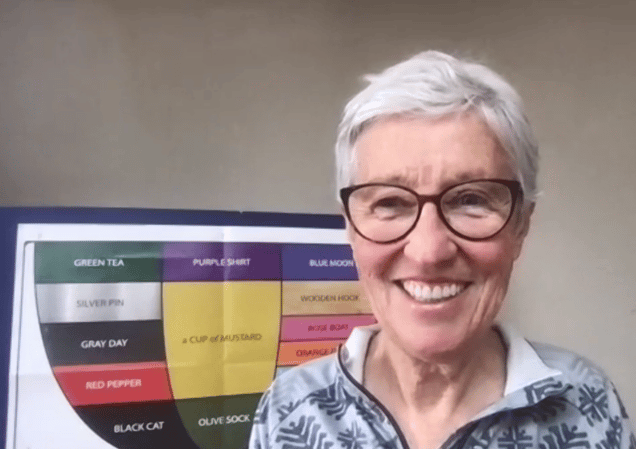
Today, Dorly is a Level 3 Certified Color Vowel Teacher Trainer.
An important part of becoming a Level 3 Trainer is the Capstone Project. We ask Trainers to look beyond mastery of the Color Vowel Approach itself and consider a larger question: What connection are you uniquely positioned to make?
The Capstone invites Trainers to draw upon their own professional experience, communities, relationships, and interests to identify a genuine need—and then imagine how Color Vowel might become part of the response.
For Dorly, the connection was natural.
Her years as an educator in the United States, her Brazilian roots, her relationship with Partners of the Americas, and her growing expertise as a Color Vowel Trainer converged around an idea: What if we could bring high-quality Color Vowel professional development to English teachers in Brazil?
That idea became STEP.
There is something particularly meaningful to us about the way this program came into being. Dorly didn't simply bring Color Vowel to a new audience. She brought together communities that were already part of her life and created something none of them could have created in quite the same way without the others.
That is exactly the kind of leadership we hope advanced Color Vowel Trainers will develop.
Learning deeply enough to teach differently
By Week 3, our conversations had shifted to one of the fascinating differences between Portuguese and English: the ways the two languages organize syllables.
Participant Tatianne wrote in her exit ticket:
“Extremely relevant class for me, learning how English syllable structure is very different from Portuguese. I feel privileged to learn with these amazing instructors, and I'm receiving really valuable feedback from my coaches.”
Another participant, Karina, described something every enthusiastic learner—and every teacher—will recognize:
“I leave class with my brain bubbling and searching for more pairs of words for certain colors. I'm surprised at what the method brings and look forward to learning more and implementing it!”
“I leave class with my brain bubbling.”
We love that.
Because curiosity is exactly what we hope to cultivate through Color Vowel training. Rather than memorizing a set of pronunciation rules, teachers begin noticing patterns. They start listening differently. They test hypotheses. They compare words. They ask better questions.
And eventually, they begin creating those same moments of discovery for their students.
Why STEP stays small
There is another unusual aspect of this program.
We deliberately cap each STEP cohort at 12 participants.
In a world of online courses designed to reach hundreds—or thousands—of learners at once, that may seem counterintuitive.
But STEP isn't mass-delivered professional development.
It is, by design, small-batch teacher development.
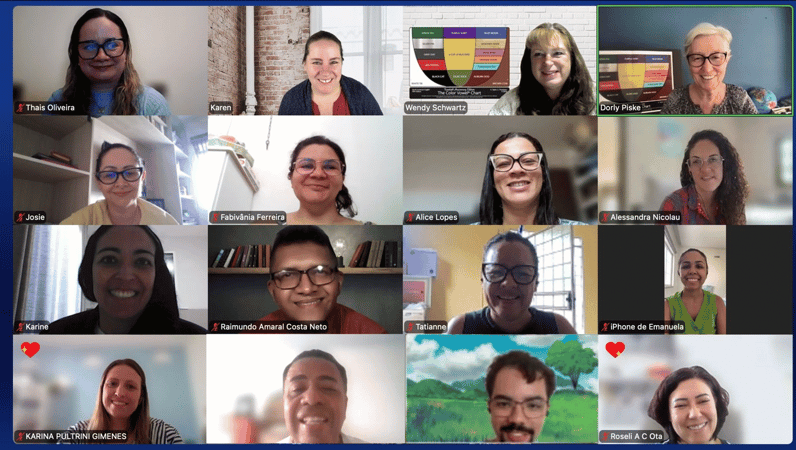
Every participant brings their own language awareness, teaching context, and unique strengths. Much of the learning happens through practicum tasks in which teachers must demonstrate that they can use what they're learning—not simply recognize it on a quiz.
That requires human attention.
Each STEP cohort is therefore taught by an expert Color Vowel Trainer and supported by three highly trained Practicum Coaches, along with a course moderator. Participants receive individualized feedback on their work while also learning alongside a close-knit cohort of fellow educators.
Together, we build something that is difficult to replicate at scale: a genuine community of support.
We want teachers to feel safe enough to take risks, to become curious about what they don't yet understand, and be able to recognize that high standards and joyful learning aren't opposites.
In fact, we believe they belong together.
Twelve teachers—and many more students
The twelve educators in this year's STEP cohort come from communities across Brazil.
Each teacher will finish the program with knowledge and skills that can travel far beyond our virtual classroom.
They will carry them into their own classrooms.
Their students will encounter new ways of listening to English, seeing its sound patterns, feeling its rhythm, and understanding how spoken English works. Those students will carry what they learn into other classrooms, workplaces, and communities.
That is how effective teacher development multiplies.
But we are beginning to see another possibility as well.
What's next? From training to implementation—and mentorship
Completing Level 1 training is an important milestone, but in many ways it marks a beginning rather than an end.
As the teachers in this STEP cohort begin bringing Color Vowel into their classrooms, a new question emerges: What would become possible if their initial training were followed by ongoing implementation coaching and support?
There is tremendous promise in connecting online professional development with opportunities for onsite observation, coaching, collaboration, and classroom-based learning in Brazil. Teachers could receive support as they adapt what they have learned to their particular students, curricula, schools, and communities.
And then there is an even more exciting possibility.
The twelve teachers participating in STEP today need not remain only recipients of professional development. With continued experience and support, some may become mentors and resources for the teachers who come after them.
In other words, STEP has the potential to grow without losing the very quality that makes it powerful.
Not by turning a 12-person experience into a 1,200-person online course, but by developing people who can develop other people.
In many ways, that brings us back to Dorly.
STEP began because one educator saw a connection between her own life, her communities, and something she had learned—and decided to build a bridge.
What if this first generation of STEP teachers could eventually build bridges of their own?
Help STEP continue
That future will require investment.
The Colorado Chapter of Partners of the Americas is raising funds to make STEP available to Brazilian public-school educators at no cost to participating teachers and to support the continuation and growth of this work.
Because STEP intentionally remains small, individualized, and coaching-intensive, each cohort represents a significant investment of time and expertise.
We believe these teachers are worth that investment.
A donation doesn't simply provide access to 20 hours of professional development. It helps develop teachers who can bring new knowledge and practices into their classrooms, reach generations of students, support colleagues—and perhaps, over time, become mentors and teacher leaders themselves.
Dorly's story shows us what can happen when deep professional learning meets relationships, imagination, and a desire to serve.
We are only beginning to discover what these twelve teachers will do next.
Help us give them the opportunity to find out.